Put AI to work. Keep the enterprise in control.
Kindo is the AI agent management platform that gives IT, Security, Finance, and Compliance one control center for every AI user, chatbot, and agent. Any agent builder, any model, any data source.
Shadow AI and sanctioned agents in one registry, each with an owner.
One policy for what each agent can reach, inherited from the person who runs it.
Tokens and spend by agent, owner, and team.


The Most Innovative Companies Trust Kindo






Kindo is an AI Management Platform that puts the enterprise in control.
Build agents in Kindo, manage agents built elsewhere, and set the rules for how agents use data, models, and tools to securely scale AI for technical operations.
Model agnostic
Deployment agnostic
Enterprise agentic platform
Full AI cost visibility and control
AI has moved from answering questions to running operations.
AI is beginning to investigate alerts, change infrastructure, provision access, build software and complete work across enterprise systems. Once agents can act, the challenge changes. Enterprises need more than approved models and acceptable-use policies. They need an operating layer that stays with the work.
Kindo gives technical and governance teams a shared way to understand what AI is doing, define the boundaries, support agents in production and keep evidence of the decisions and actions that follow.


Answers
Acts
Operates within enterprise controls

More agents do not create an operating model.
Teams are adopting models, building agents, enabling AI inside SaaS platforms and connecting new tools to sensitive data. Each project may work on its own. The result is fragmented ownership, inconsistent controls, difficult support and cost that becomes visible only after it accumulates.
An AI estate no one fully sees
Control that stops at the policy document
Agents without an operations team
Spend without operational context
One control layer between operator intent and enterprise action.
Kindo brings agents, models, data access, enterprise tools, policy and operational oversight into one agent harness. Teams build and run agentic workflows while IT, security, compliance and finance keep the visibility and control required to support them at scale.
The platform does not ask you to replace the systems you already trust. It connects AI to those systems through a governed execution path: from intent to action, and from action to evidence.
People and events
Operators, approved triggers, scheduled work
Kindo agent harness
Context, agents, models, policy, permissions, cost controls
Enterprise systems
Cloud, identity, code, security, ITSM, data, collaboration tools
Verified outcomes
Action, approval, evidence, operational learning
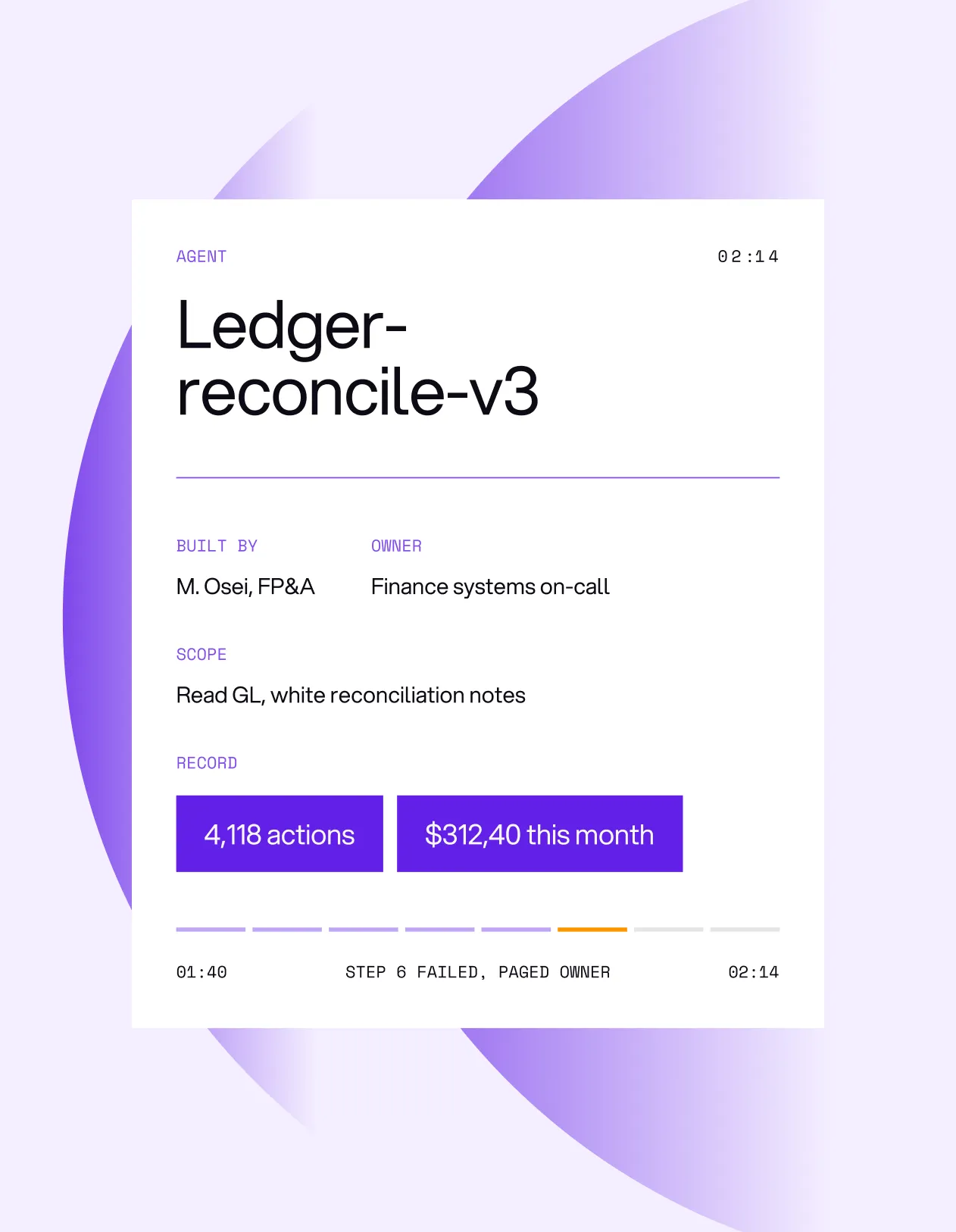
The agent your finance team built just broke.
Who gets paged?
It reconciled forty ledgers a night for three months and nobody noticed it existed. Tonight it stopped on the sixth. Somewhere there is a person who should know, a scope it should never have exceeded, and a log that says what it did. On Kindo, all three are already captured.
You have a network operations center. You need one for AI.
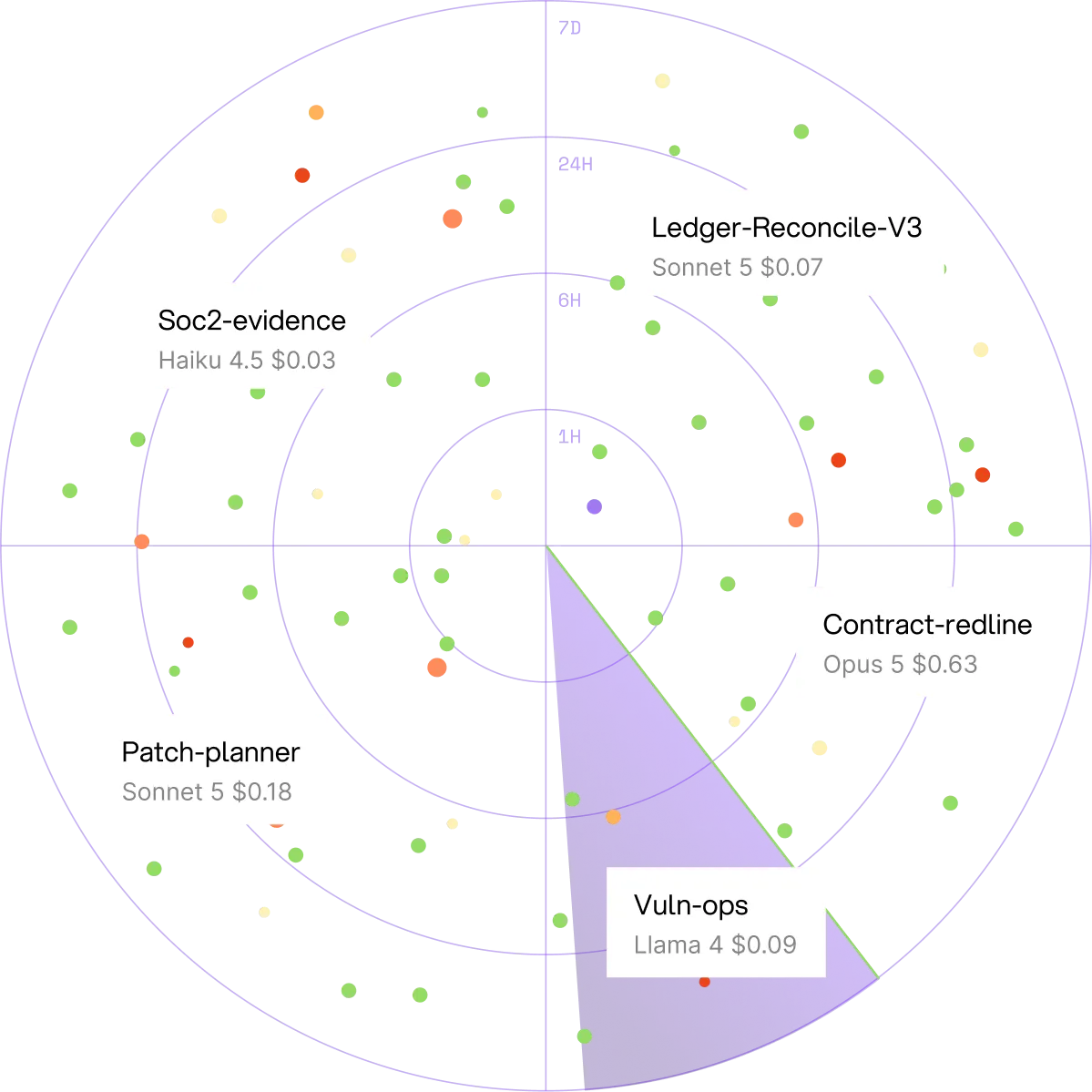
Every agent in the company on one screen: who built it, who owns it, what it can touch, what it is doing right now and what it has cost since midnight. Running, needs a hand, completed. Filter by team, by model, by data it reaches.
When the CFO asks what AI cost this quarter, this is the page. When the auditor asks who approved an agent that touches customer data, this is the page. When something breaks at two in the morning, this is the page the on-call opens first.
Control the agent lifecycle from one operating layer.
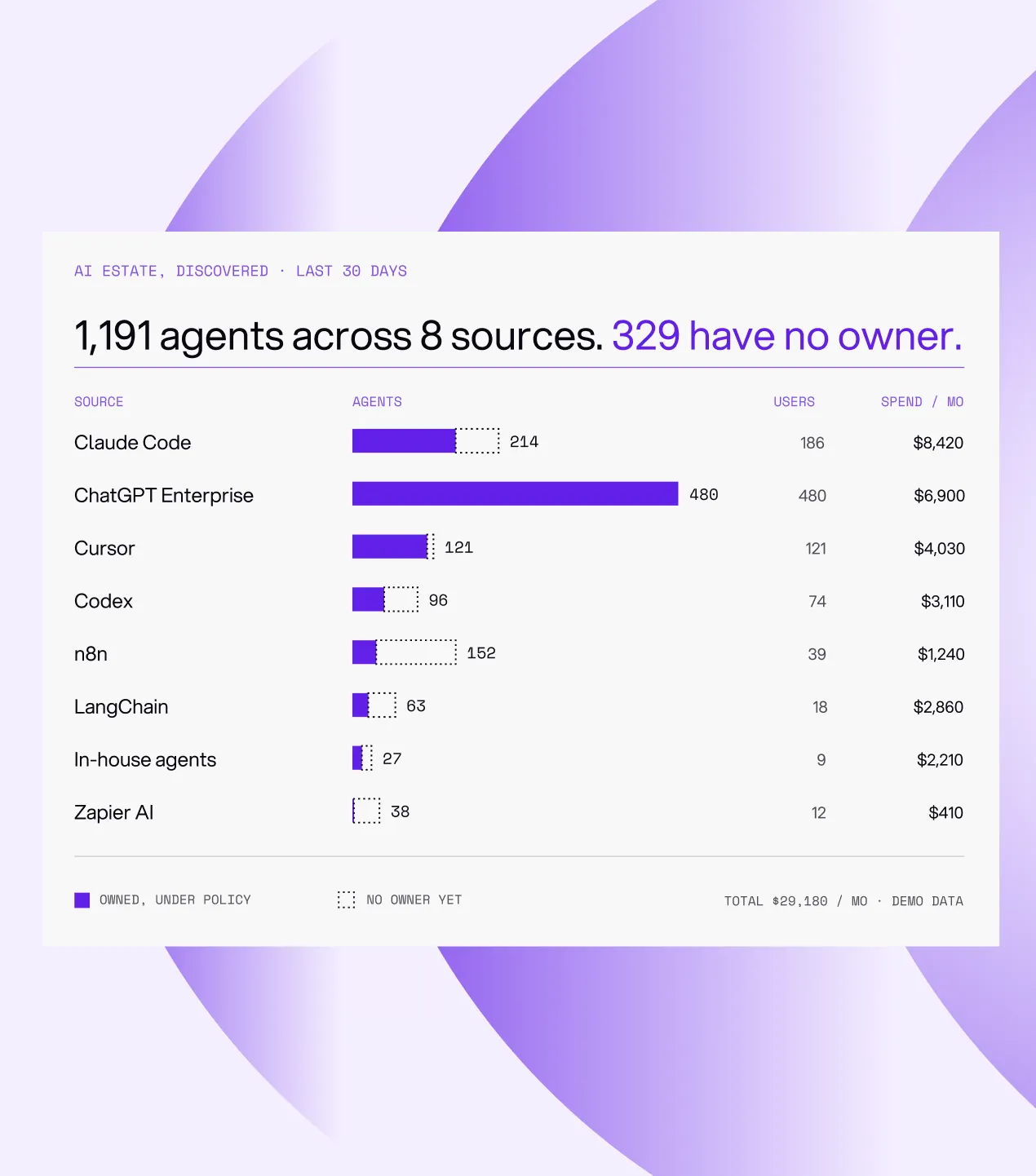
1.
Discover the AI estate
Find AI providers, agents, users, activity, data relationships and spend across supported enterprise sources. Build the baseline needed for governance and investment decisions.
.webp)
2.
Govern access and execution
Apply AI agent governance where agents act. Define who can run or share an agent, which models, data, MCP servers, and credentials it can reach, and when approval is required.
.webp)
3.
Operate and support
Monitor every agent in production, with status, cost, and owner in one view. Pause or adjust a run when it needs a hand, and route failures to a named owner, not the employee who built it.
.webp)
4.
Build and automate
Build AI agents in natural language, or bring in agents built elsewhere, in one governed place. Run them on events, schedules, or operator requests across security, DevOps, and IT.
.webp)
5.
Prove the outcome
Keep one audit trail of what people and agents did, which data they touched, and what it cost. Give the auditor, the CFO, and the incident review the same evidence, with AI cost attributed by agent, owner, and team.
Build in Kindo. Connect what your teams already use.
Give employees a governed place to use AI and create agents, while bringing approved external tools into the same operating model. Kindo provides the interfaces, APIs, controls and execution environment needed to turn useful experiments into work that central teams can support.
Action chat
Action bot and agent builder
Kindo extensions
APIs and connected agents
One platform. Many ways to put it to work.
AI discovery and governance
Find shadow AI, map ownership and data relationships, apply policy and build a current view of AI activity, cost and risk.
Govern enterprise AISecurity operations
Use agents to investigate alerts, enrich cases, support threat hunting and run approved response workflows with a record of the work.
Strengthen security operationsDevOps and infrastructure
Apply agentic execution to CI/CD, cloud operations, reliability, drift and infrastructure response without another automation silo.
Advance DevOps operationsIT, identity and compliance
Automate lifecycle tasks, access reviews, evidence collection, policy checks and reporting across connected systems.
Modernize IT operationsControl belongs in the execution path.
Kindo applies enterprise policy as agents access models, credentials, data and tools. Teams define who may run or share an agent, which resources it may use, when approval is required and how activity is recorded.
Identity and permissions
Data and secrets
Models and cost
Action and approval
Audit and evidence
Monitoring and intervention
Run AI where
the mission requires.
Choose the deployment model that fits the sensitivity of the work and the architecture of the environment. Kindo supports teams that want rapid SaaS deployment as well as organizations that need direct control over infrastructure, models, data and credentials, including public-sector and mission-driven teams.
Kindo cloud
Launch quickly in Kindo's SOC 2 SaaS environment.
Self-managed cloud
Run Kindo in your cloud and Kubernetes environment with control over integrations, data flows and infrastructure.
On premises
Operate Kindo inside enterprise-managed infrastructure for sensitive and regulated workloads.
Air-gapped
Disconnected environments where external services and identity dependencies are restricted.
Private offensive AI for authorized security work.
Deep Hat is Kindo's purpose-built cybersecurity model for red teams and security operators. It supports adversarial reasoning, attack-path analysis, vulnerability research and authorized testing where privacy and model control matter.
Run Deep Hat inside the agent harness so offensive capability operates with defined access, isolated execution and a reviewable record of activity.
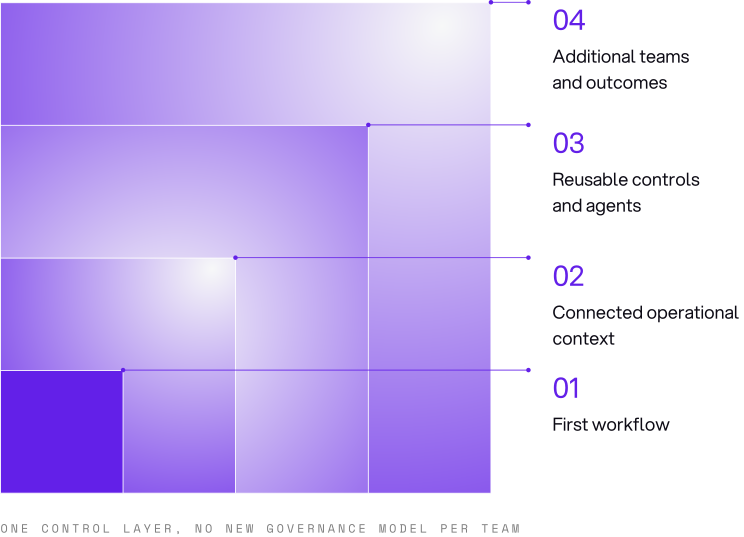

A typical first engagement
Scope one to three use cases
Agreed success criteria
Systems connected
SIEM, ITSM, identity, cloud
Measured against the criteria
Time, cost, findings closed
First agent live
Built with your team, in the room
Internal builders enabled
Reusable agents and patterns handed over
For the CEO
"How do I say yes without losing the plot?"
One platform your teams build on, one record you own. Adoption goes up because the rules travel with the agent, not with the memo.
For the CISO
"What can this thing actually touch?"
Exactly what its operator can, and nothing more. Permissions are inherited, not granted twice. Every action is logged before it lands.
For the CFO
"What did AI cost us this quarter, by team?"
Every token attributed to an agent, an owner and a cost center. Budgets and hard stops per team, set once, enforced in the platform.
Real work.
Measurable results.
"We used Kindo to accelerate and simplify our threat-hunting processes, which enabled us to increase the value of our existing SIEM infrastructure and identify issues before they became real problems. The time and potential impact have resulted in a cost savings of over $2M per year, and growing."
$2M+
80%
50 to 70%
300+
4


Move beyond disconnected AI and brittle automation.
Approach
Where it helps
Where the operating gap remains
Approach
Kindo
Where it helps
A shared control and execution layer across agentic technical operations
Where the operating gap remains
Start with one focused use case and expand through a common governance and support model
Approach
AI assistants and copilots
Where it helps
Help individuals answer questions and complete bounded tasks
Where the operating gap remains
Central teams have little ability to operate, support or govern the work across providers
Approach
Point AI solutions
Where it helps
Address one workflow or functional problem quickly
Where the operating gap remains
Each product brings its own controls, data relationships, cost model and operational silo
Approach
Traditional workflow automation
Where it helps
Executes predefined steps reliably
Where the operating gap remains
Complex workflows need ongoing scripting and struggle when context or conditions change