PENTEST AUTOMATION
Autonomous penetration testing: authorized, continuous, with a human at every gate
AI agents plan and run authorized tests against your own systems, continuously. Deep Hat, Kindo’s cybersecurity model, does the reasoning inside a governed agent harness. Scope, permissions, and every action: controlled and recorded. Anything disruptive waits for a person.
Authorized scope
Tester-scoped permissions
Human-in-the-loop gates
Full record
Air-gapped supported
What is autonomous penetration testing?
Autonomous penetration testing is penetration testing by AI agents that reason about a target, choose techniques, execute them, and report findings, within a scope and rules of engagement the organization sets. On Kindo it runs on Deep Hat, Kindo’s cybersecurity model, as governed agents in the agent harness.
Not the same as
Vulnerability scanning
Known signatures. No reasoning, no chained techniques.
Not the same as
Manual pentesting
Periodic. Limited by tester hours. Months between engagements.
With Kindo
Autonomous, governed testing
Continuous. Agent-driven within scope. A person approves anything that could cause harm.
Done well: continuous, repeatable testing between engagements. Done badly: an unsupervised agent with offensive tooling and production access. The difference is governance.
Why does AI penetration testing need
a control layer?
An agent capable of attack-path analysis and exploitation must be constrained more tightly than any other agent in the enterprise. Five things must be true before it runs.
Explicit, enforced scope
Targets and rules of engagement set by an admin, not a prompt.
Tester-scoped permissions
No broader than the authorized tester’s. From your identity provider.
Approval gates
Before any step that could alter, disrupt, or exfiltrate.
Governed execution
Inside Kindo’s agent harness. Gateways control data and model access.
A complete record
Every command, result, approval. Reviewable after the fact.
A hosted general-purpose model
What security teams need, provided by Kindo
Not trained for adversarial reasoning
A model built for adversarial reasoning, attack-path analysis, and vulnerability research
Often refuses authorized offensive work
Built for authorized security work, with a person approving disruptive steps
Sends your target details to a third party’s cloud
Runs where you control it: Kindo cloud, your cloud, on premises, air-gapped
No scope, no gates, no record beyond a chat history
A harness that enforces scope and gates and keeps the record
What problems does Kindo solve?
Four gaps that annual engagements and scanners leave open. A governed agent closes each; scanners and external testers stay in the picture.
Months between engagements
Changes ship. CVEs drop. Nothing re-tested until next year.
Kindo → Scheduled re-tests after changes, deployments, disclosures. Same scope and gates every run.
External engagements continue, from better ground.
Tester hours spent on recon
Enumeration eats the budget before the interesting work starts.
Kindo → Deep Hat maps the target within scope and proposes a plan with its reasoning.
Your red team reviews and directs.
Detections never validated
Rules tuned against assumptions, not realistic techniques.
Kindo → Gated, in-scope techniques give the SOC real signals to validate against.
Your SIEM and EDR keep detecting.
Findings without evidence
Lists, no reproduction steps, no path to a ticket.
Kindo → Ranked findings with evidence and reproduction steps. Tickets to ServiceNow or Jira.
Remediation can run as a Kindo agent under the same governance.
How does Kindo run pentest automation?
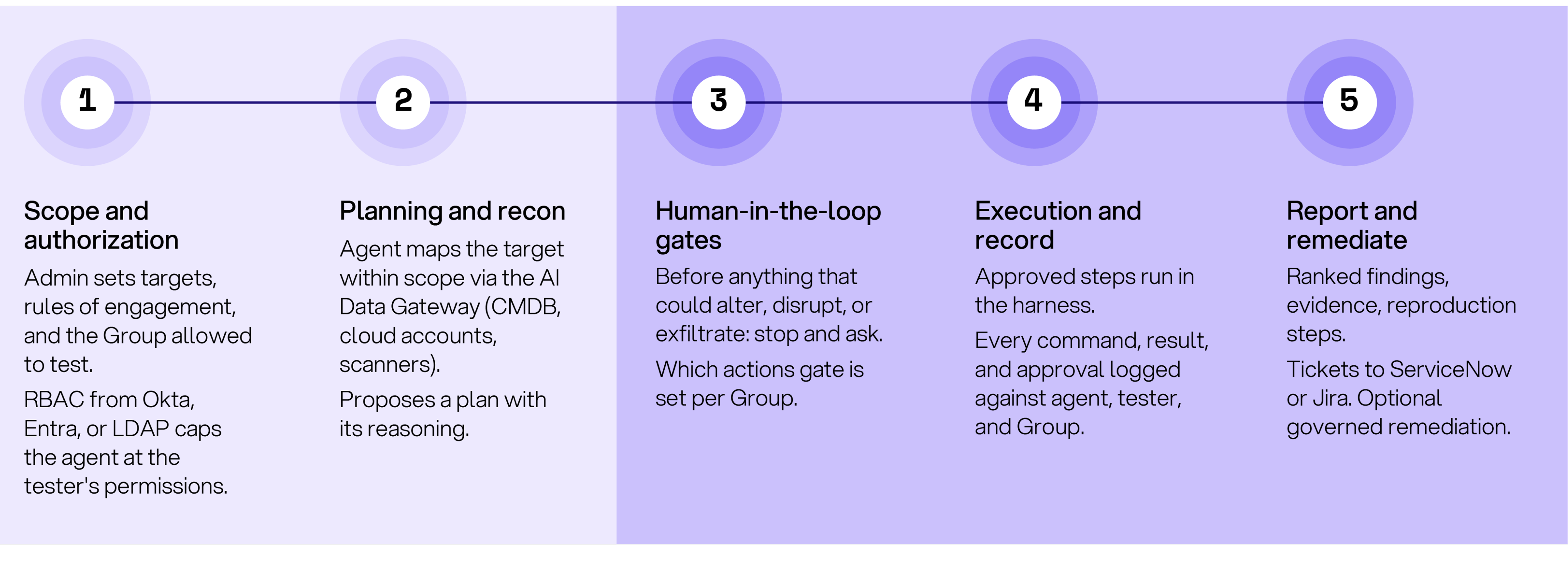
Deep Hat reasons. The agent harness executes. Kindo’s three core capabilities control what the agent can see and do. Five stages, every one recorded.
The model
Deep Hat, Kindo’s cybersecurity model
Built for red teams and security operators doing authorized work. Runs inside Kindo’s agent harness.
Built for
Adversarial reasoning, attack-path analysis, vulnerability research
Runs in
Kindo cloud, your cloud, on premises, air-gapped
Controlled by
RBAC, AI Data Gateway, AI Model Gateway
ALL IN YOUR ENVIRONMENT
Tooling and findings stay where Kindo runs.
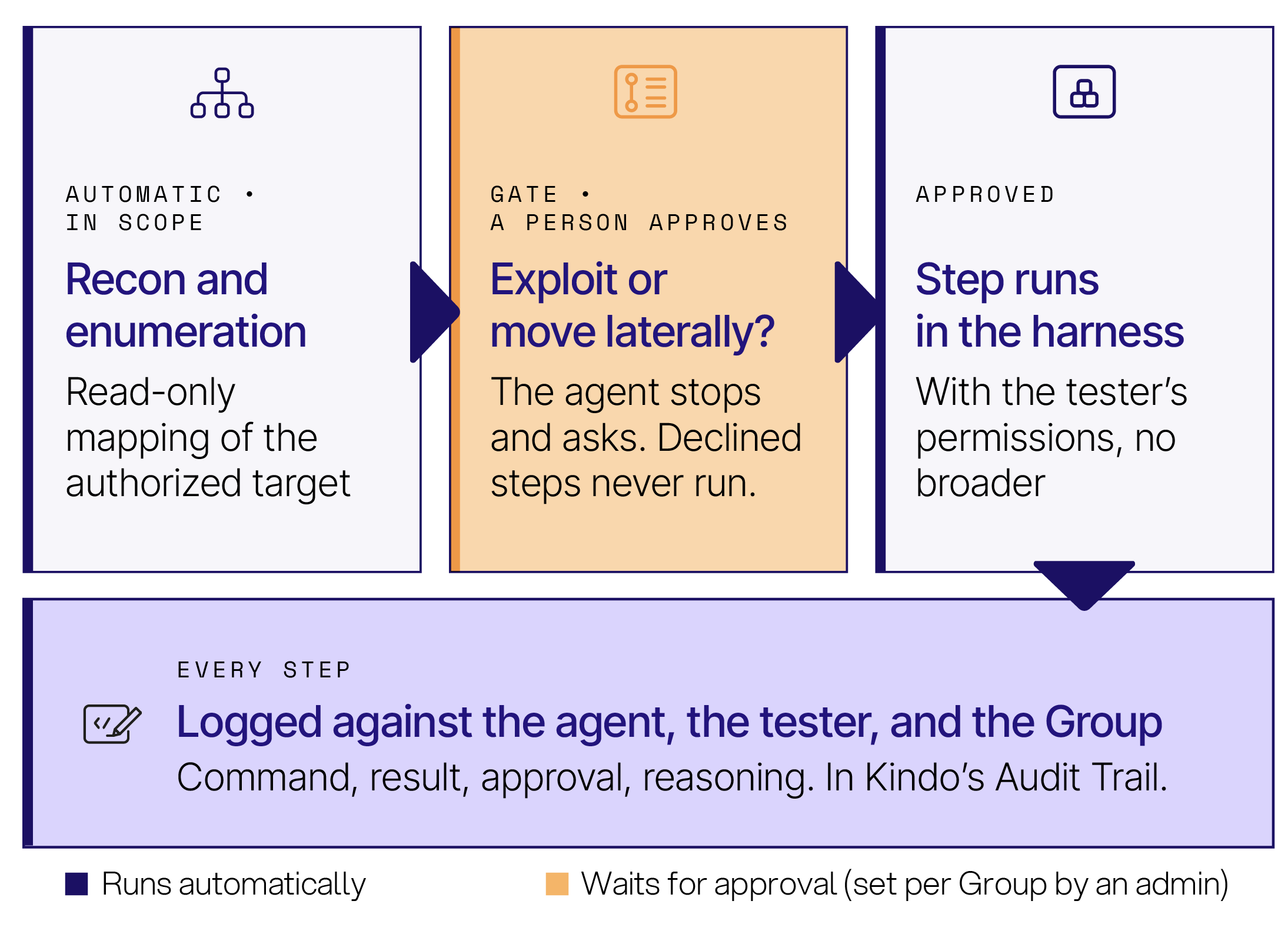
Automatic
Read-only enumeration and mapping, within scope
Waits for a person
Exploitation, lateral movement, anything that alters, disrupts, or exfiltrates
Who sets gates
An admin, per Group. Policy, not a prompt the agent can argue with.
Who runs tests
Members of the authorized Group, with their own identity-provider permissions
Recorded
Every command, result, approval, and the agent’s reasoning. Audit Trail.
Results go to
A ranked report; tickets to ServiceNow or Jira
What will you gain?
Continuous pentesting between engagements: same scope, gates, and record every run. Results that trend.
Coverage
No gap between engagements
Scheduled runs cover the months an annual test leaves open.
Timing
Re-test on change
Deployments, config changes, new CVE disclosures.
Output
Findings you can act on
Ranked. Evidence and reproduction steps. Routed to tickets.
Trend
Results over time
Same scope and record each run, so posture is comparable.
Before
One engagement a year
Hours on recon. Findings as a list. Months with nothing re-tested.
With Kindo
Continuous, governed testing
In-scope tests on a schedule and on change. A person approves every disruptive step. Every action on record.
External engagement
Starts from better ground
Testers begin with Kindo’s findings and trend data, not a blank map.
Who is autonomous penetration testing for?
Red teams, blue teams and SOCs, and application security teams that need testing more often than engagements allow, and need it governed.
Red teams
Scale recon and attack-path analysis
Deep Hat maps and proposes. The team directs and approves.
Blue teams and SOCs
Validate detections against real techniques
Pairs with SOC Automation on the same platform.
Application security
Continuous testing of internet-facing systems
Re-test on every deployment, within an authorized scope.
Systems you own or are authorized in writing to test
A need to test between engagements, not only annually
Offensive tooling and findings must stay in your environment
Why choose Kindo for AI red team and security testing?
A model built for adversarial work, and a harness that governs it. Comparison by category; your scanners and external testers keep their jobs.
Approach
Trained for adversarial work
Where it runs
Scope and permissions
Gates
Record
Hosted general-purpose model
No; often refuses
Third-party cloud
Whatever the prompt says
None
Chat history
Point pentest tool
Varies
Vendor cloud or appliance
Tool-specific
Varies
Tool log, separate from your other AI
Manual engagement
Yes (people)
On site or remote
Contract and rules of engagement
Tester judgment
Report
Kindo with Deep Hat
Yes
Kindo cloud, yours, on premises, air-gapped
Admin-defined scope; tester’s RBAC permissions
Per-Group approval before disruptive steps
Every command, result, approval, reasoning. Audit trail.
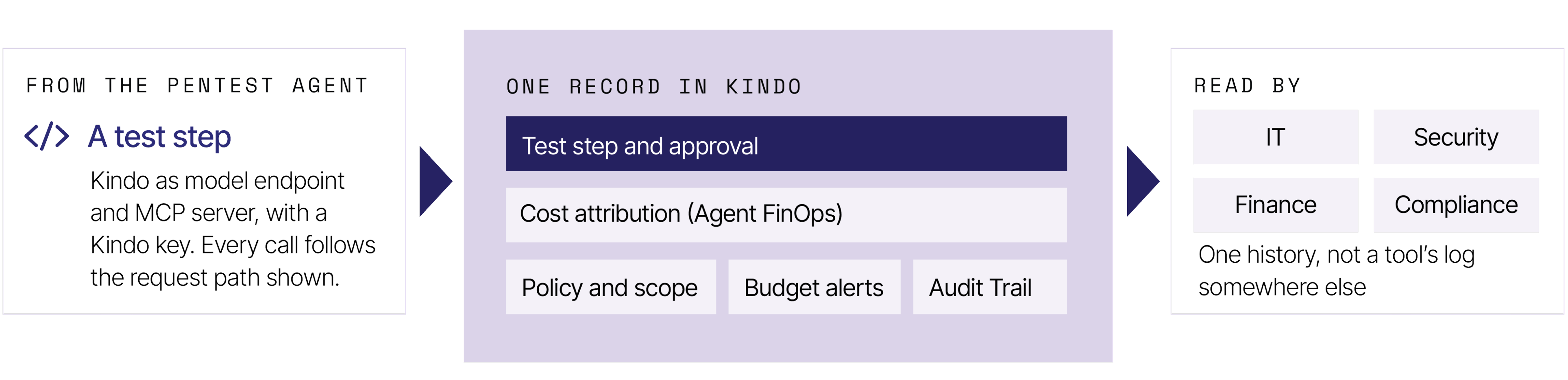
Where the test lands: in the same record as everything else Kindo knows about the agent.
Kindo cloud
Your cloud
On premises
Air-gapped

Frequently Asked Questions
Is autonomous penetration testing legal?
Yes, against systems you own or are authorized in writing to test, within agreed rules of engagement. Kindo enforces scope and authorization through RBAC and logs every action.
Can an AI agent cause damage during a test?
Not without a person saying so. Disruptive actions wait behind an approval gate, the agent is capped at the tester’s permissions, and execution runs inside Kindo’s governed harness. A declined step never runs; the decline is recorded.
Why not use a general-purpose model for pentesting?
Hosted general-purpose models are not trained for adversarial work, often refuse it, and send your target details to a third party. Deep Hat is built for authorized security work and runs where you control it.
Does this replace our external pentest?
No. It covers the time between engagements and gives external testers a better starting point: current findings, trend data, a record of what has been tested.
Who sees the findings and the record?
Members of the authorized Group, plus whoever your admin grants read access through RBAC. Findings and the full action record sit in Kindo’s Audit Trail beside the agent’s cost and policy history.
What happens when a gate is declined?
The step does not run. The decline is recorded with the approver. The agent continues with the next in-scope step that needs no approval, or stops if the plan cannot proceed.
Can we run this air-gapped?
Yes. Deep Hat and the full Kindo platform are built to run on premises or fully air-gapped. Offensive tooling and findings never leave your environment.