AI Cost Control · Use case
AI cost control starts with knowing what drives the bill
An agent can make dozens of model calls to finish one task, and the provider invoice can't tell you who spent what or why. Kindo, the AI agent management platform, shows every model call by agent, owner, and team, and budget alerts warn you before a threshold becomes a surprise.
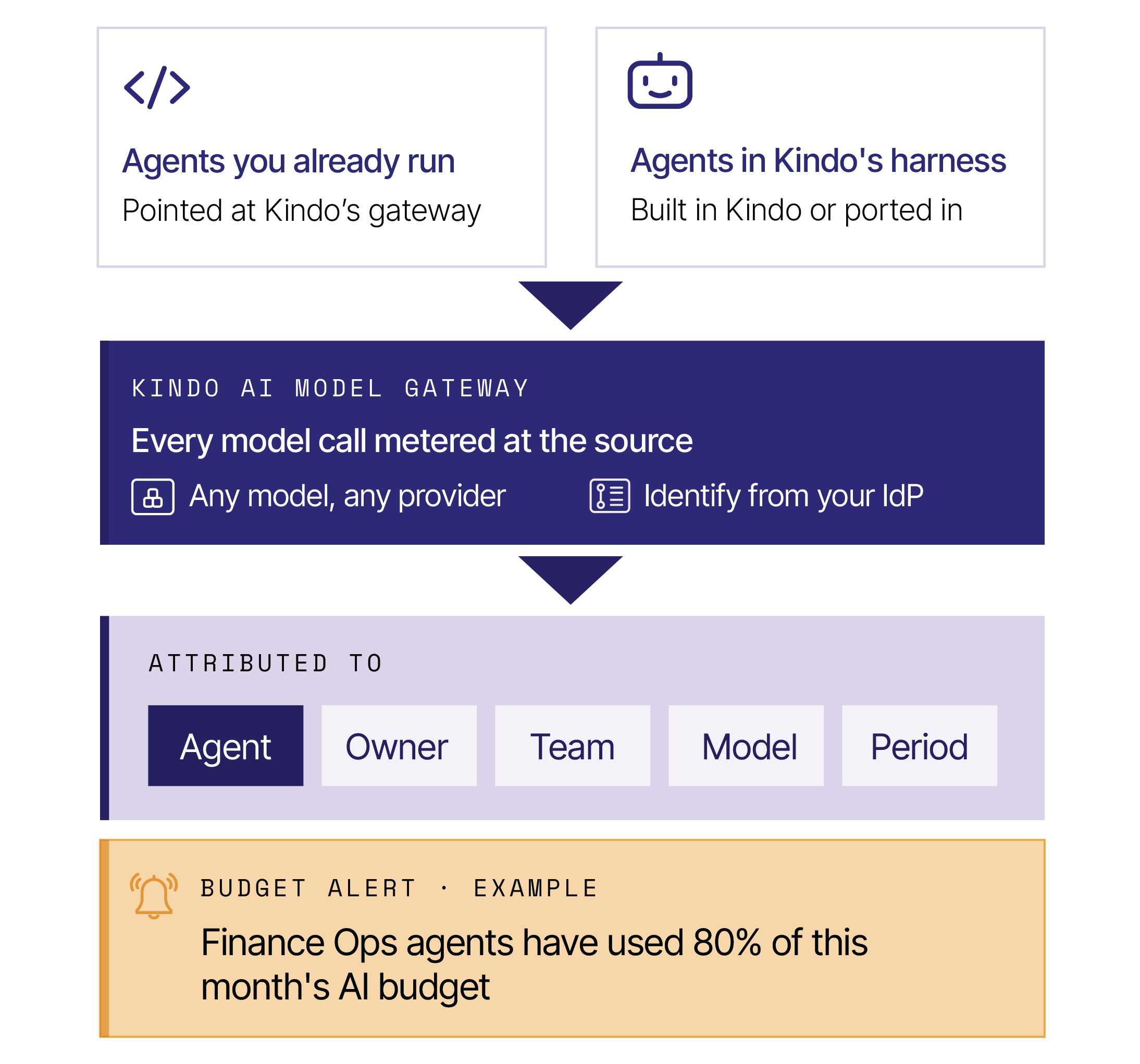
Any agent, via Kindo's gateway
Spend by agent, owner, and team
Budget alerts · Model access policy
Any model, any provider · No rebuild
Kindo cloud · your cloud · on premises · air-gapped
Any agent, via Kindo's gateway
Spend by agent, owner, and team
Budget alerts
Model access policy
Any model, any provider
No rebuild
Kindo cloud · your cloud · on premises · air-gapped
Budget alerts
Any agent, via Kindo's gateway
What is AI cost control?
What is AI cost control?
AI cost control is the practice of tying every AI model call to the agent that made it, the person who owns it, and the team it serves, then using budget alerts and model access policy so AI spend is planned rather than discovered.
What it is
Spend with an owner
Every token to an agent, owner, and team
Seen
At every model call
Not weeks later on an invoice
Attributed
To people you already manage
Your existing identities and teams
Controls
Budget alerts, model access
Who may use which model, and when spend nears a limit
Not
A smaller invoice
An invoice that explains itself
After the fact
Cloud FinOps
Reads the provider invoice and cloud line items. Sees what was spent, not which agent spent it.
By key
Gateway metering
Counts tokens per API key. Keys are shared; owners and teams are invisible.
The result
AI cost control
Metered at the call, attributed to a named person and team, with alerts and policy on top. What an AI agent management platform does for cost.
Why does AI spending get harder to manage?
Why is AI spending hard to manage?
Agents turn one request into many model calls, and the provider invoice cannot show who generated the cost or what work it supported. The CFO's question, "What did AI cost us this quarter, by team?" goes unanswered.
The invoice says
Finance needs to know
Spend per API key. A handful of keys shared across many teams and tools.
Which team, and which person, is accountable for it.
Tokens per model, totaled for the month.
Which agent spent them, and on what work.
One provider per invoice. Several providers, several bills.
One view across every model and provider in use.
Arrives after the month closes.
A warning while there is still budget left to protect.
Why AI spend compounds
Each task
Many model calls
Planning, retries, tools, sub-agents
Every agent
<15
150,000+
Agents per Fortune 500 company
2025 to 2028, Gartner projection
The result
An invoice with totals, not owners
Nobody can say who spent it, or on what
With Kindo
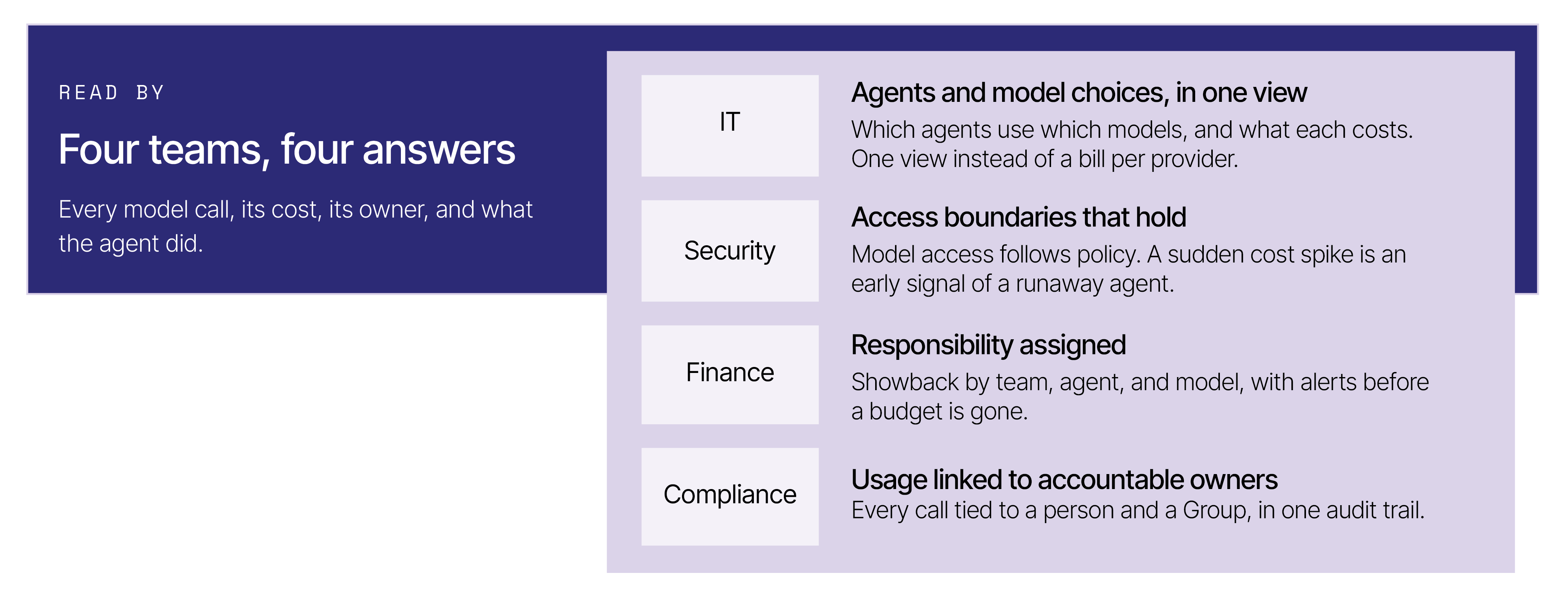
One view: every call, its cost, its owner, and what the agent did.
IT
Security
Finance
Compliance
Projection source: Gartner, Market Overview: AI Agent Management Platforms, July 2026. Model calls per task are illustrative.
What cost problems does Kindo help solve?
Cost problems
Kindo solves
Kindo answers the six questions Finance and IT ask about AI spend and cost management, from one place. Your provider contracts and finance systems stay.
Attribution
How do I track AI and LLM costs by team and owner?
Shared keys hide who spent what.
Kindo → Kindo ties every model call to an agent, an owner, and a team.
Budgets
How do I know before a budget is gone?
Overruns surface when the invoice lands.
Kindo → Kindo sends a budget alert at the threshold you set.
Model access
How do I keep expensive models for the work that needs them?
Every builder's model choice is a price decision nobody approved.
Kindo → Kindo's model access policy sets which teams may use which models.
Efficiency
How do I pay for AI judgment, not routine work?
Agents send everything to a model, including work that needs none.
Kindo → In Kindo's harness, routine steps skip the model and simpler work goes to cheaper models.
Runaway agents
How do I spot a runaway agent before the bill does?
An agent in a retry loop spends until someone notices.
Kindo → Kindo shows spend per agent and alerts you when it crosses a threshold.
Unseen spend
What about AI spend that never touches Kindo?
AI subscriptions bought on expense reports sit outside any gateway.
Kindo → Kindo's free shadow AI assessment finds AI tools on your expense reports.
How does Kindo help you manage AI costs?
How does Kindo help manage AI costs?
Kindo, the enterprise AI control center, sits between your agents and the models they call: it sees every call, ties it to an owner, and applies your budget and model policies. No rebuild for agents you already run.
1
Connect
Point your agents' model calls at Kindo, whatever built them. Keep your existing AI gateway if you have one.
2
Attribute
Every call tied to an agent, owner, and team, using the identities you already manage.
3
Control
Budget alerts and model access policy, set once for every agent.
4
Optimize · agents in Kindo's harness
Pay a model only where judgment is needed.
Any agent · via Kindo's gateway
Spend by agent, owner, team
Budget alerts
Model access policy
Any model, any provider
Agents in Kindo's harness · plus
Routine steps without a model
Right model per step
Skip runs that find nothing
What will your teams gain?
What you gain
One record of AI spend that IT, Security, Finance, and Compliance all read, with an owner on every line. A bill that explains itself.
Cost attribution is the spending side of ROI. Measuring return also needs the outcome: work completed, quality, time saved. Kindo puts each agent's actions on the same record as its cost, so both sides can be read together.
Who needs AI cost control?
Who needs AI cost control?
CFO and FP&A
"What did AI cost us, by team?"
Spend with an owner on every line, and a warning before a budget is gone.
CIO and AI platform leader
Say yes to more agents, with the cost in view
Every model and provider in one place. Keep your existing gateway or model hub.
FinOps teams
Extend cloud cost practice to AI
Owners, budgets, and alerts, at the level of the agent and the model call.
Answers
AI spend across several model providers, or several teams on shared keys
Answers
Agents running unattended, where spend can grow with nobody watching
Answers
Leadership asking for AI cost by team, and for ROI
Why choose Kindo for AI cost control and AI FinOps?
Why choose Kindo for AI cost control?
Kindo attributes AI cost to a named owner, not a key, across every agent and model you use, and runs wherever your data must stay, including on premises.
Counting tokens is not the same as knowing who spent them.
By category
Meter, or attribute and act
Your existing tools keep their jobs.
Approach
Sees
Attributes to
Before month end
Policy
Runs
Cloud FinOps tool
The provider invoice
Account or tag
No
None on AI calls
Vendor cloud
AI gateway
Traffic through it
API key
Usage counts
Model routing
Varies
AI cost tool
Usage it can read
Key or project
Dashboards
Rarely
Usually vendor cloud
Kindo
Every call routed through Kindo, any agent
Agent, owner, team, model
Budget alerts at threshold
Model and data access by Group
Kindo cloud, yours, on premises, air-gapped
The objection
"Our AI gateway already tracks tokens"
Keep it. Kindo adds what it can't see.
A gateway alone
What Kindo adds
Tokens by key. Owners unknown.
Every call tied to a named person and team.
Usage counts, with no record of the work.
Cost and actions on one record, so spend can be judged against work done.
Every task it carries is a model call.
For agents in Kindo, routine work runs without one.
The analyst view
Gartner treats agentic FinOps as core to an AI agent management platform
What Gartner says
Agentic FinOps is central. Gartner pairs it with behavioral oversight as what AI agent management platforms are for.
Agent FinOps is mandatory. Gartner lists agent FinOps and tracking among the platform's required features.
Kindo Agent FinOps
Kindo attributes every model call to an agent, an owner, and a team, with budget alerts and model access policy on top.
Source: Gartner, Market Overview: AI Agent Management Platforms, July 2026.
The analyst view
Gartner treats agentic FinOps as core to an AI agent management platform
What Gartner says
- Agentic FinOps is central. Gartner pairs it with behavioral oversight as what AI agent management platforms are for.
- Agent FinOps is mandatory. Gartner lists agent FinOps and tracking among the platform's required features.
Source: Gartner, Market Overview: AI Agent Management Platforms, July 2026.
Go deeper on AI cost control
Platform
The Enterprise AI Control Center
Three core capabilities. How any agent connects.
Use case
AI Agent Sprawl
An owner and a policy for every agent.
Use case
SOC Automation
Deep Hat Sift tames alert storms.
Placeholder · Featured resource
[Marquee resource, e.g. an agentic FinOps guide or an Agent FinOps dashboard walkthrough]
[One-line description. Swap in the real asset and link before publication.]
View resource →