AI Agent Sprawl · Use case
AI agent sprawl: turn scattered agents into one governed, owned AI estate
Every team builds agents on its own platform. Nobody sees the whole picture. Kindo, the AI agent management platform, gives IT, Security, Finance, and Compliance one registry, one policy, and one record for every agent, wherever it was built.
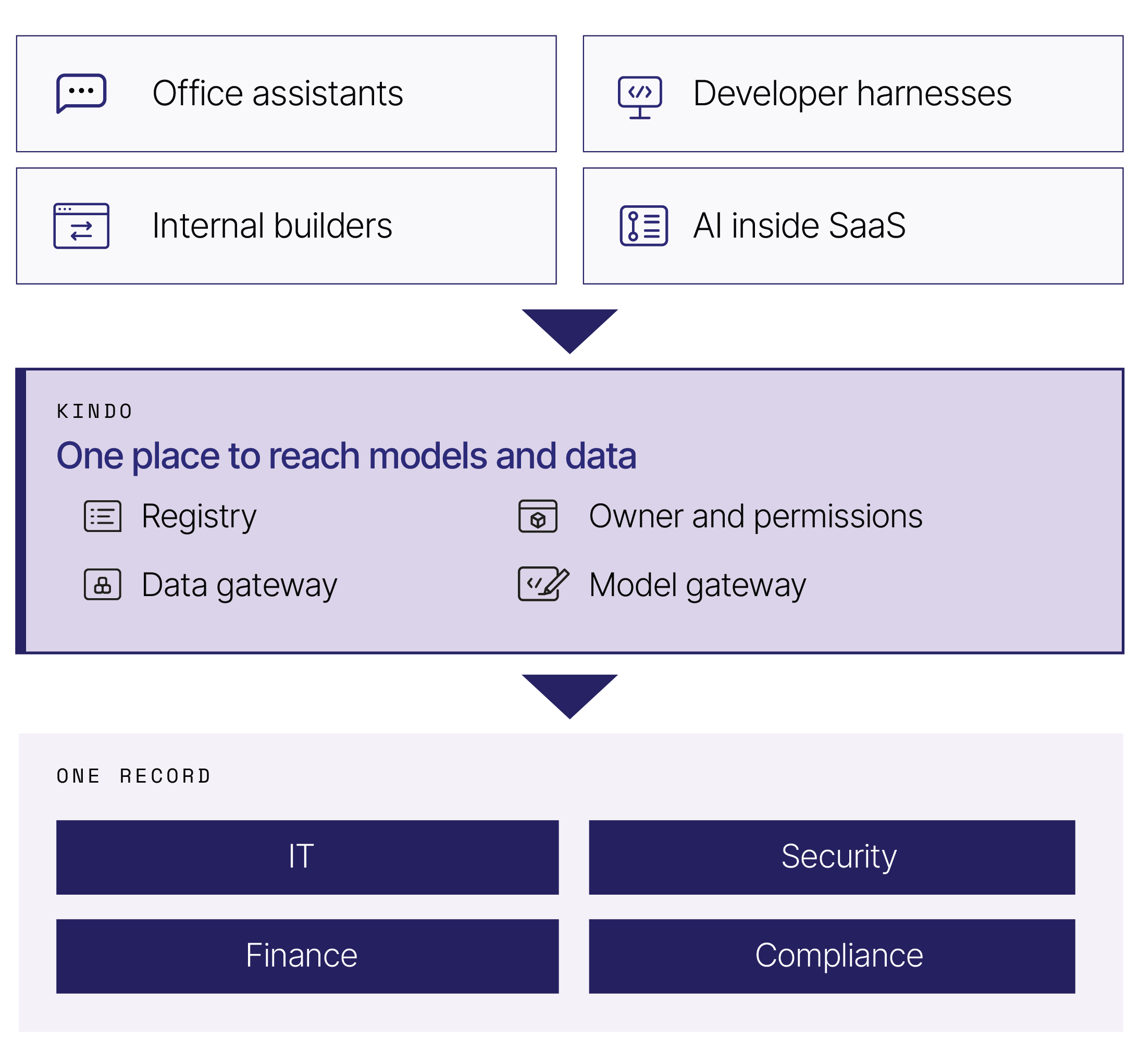
What is AI agent sprawl?
AI agent sprawl is the uncontrolled growth of AI agents across an enterprise, built on different platforms by different teams, with no shared inventory, owner, policy, or record. The AI estate is every agent, model, and tool; sprawl is the estate without management.
No inventory
Nobody holds the list
No owner
Nobody on the hook
No policy
Access is whatever the builder had
No record
What it did, what it cost: unknown
A subset
Shadow AI
The agents you don't know about. Shadow AI Discovery finds them.
The previous era
SaaS sprawl
An app waits for a person. An agent reads data and acts.
This page
AI agent sprawl
Approved agents too. Approval says someone said yes, not who owns it now or what it did last night. What an AI agent management platform manages.
Why does AI agent sprawl matter?
The agents multiply whether or not anyone is counting, and at the scale Gartner projects, sprawl cannot be managed by hand. Governance arrives before the first incident, or after it.
<15 → 150,000+
Agents at the average global Fortune 500 company, 2025 to 2028, in Gartner's projection.
50%
of agent-to-agent interactions guardrailed by AI agent management platforms by 2030.
~1 in 3
Ten agent calls at 10% error each: the task completes about a third of the time. Errors compound. So does unowned risk.
~60%
of organizations report evidence of, or suspect, unauthorized AI agent use.
Sources: Gartner, Market Overview: AI Agent Management Platforms, July 2026; Gartner, Beyond Agent Sprawl, March 2026; Gartner, Use Guardian Agents to Govern Autonomous AI Systems, September 2026. Projections are Gartner's.
What problems does Kindo solve?
Kindo answers the four questions a CIO or CISO cannot answer across builders today, from one place. The builders stay.
Inventory
One inventory of every agent, whatever built it?
Each builder keeps its own list. Nobody holds the union.
Kindo → Pre-built discovery agents read where agents leave traces. Unified AI Registry: every agent, where it runs, who owns it, what it reaches.
SIEM, identity provider, expense system stay the sources.
Ownership
An owner for every agent?
Agents outlive projects, contractors, reorgs.
Kindo → Every agent tied to a person and a Group from Okta, Entra, or LDAP. No owner, no keys.
Your identity provider stays the source of truth.
Policy
One access policy across platforms?
Each builder enforces its own rules. Or none.
Kindo → Agents reach models and data through Kindo's gateways. One policy engine, one DLP set, whatever the harness.
Your AI gateway can sit underneath as a provider.
Autonomy
Teams keep building, control stays central?
Blocking agents moves the cost: tickets, gaps, spend elsewhere.
Kindo → Build anywhere. Kindo issues the keys, meters the cost, keeps the record. Yes stays safe.
No rebuild.
Kindo answers the CISO's question: who is accountable when an autonomous agent does something destructive? On the record before it acts: owner, Group, policy, and, in Kindo's harness, the person who approved the step.
How does Kindo deliver AI agent governance across every builder?
Kindo becomes the place every agent reaches models and data, ties each agent to an owner and a policy, and keeps one record. Four steps for any agent. A fifth for agents in Kindo's harness.
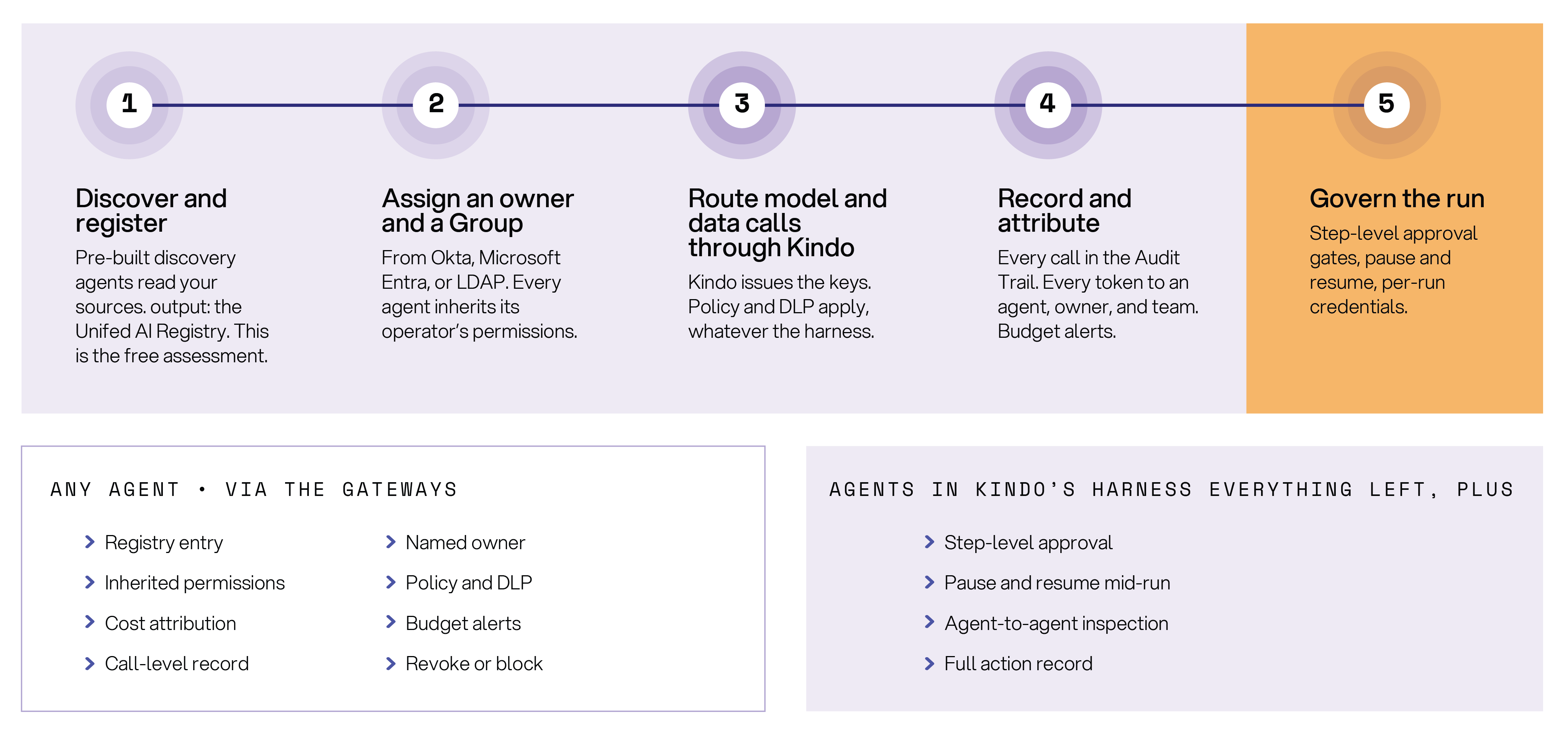
RUNS: KINDO CLOUD · YOUR CLOUD · ON PREMISES · AIR-GAPPED
KEYS ISSUED AND REVOKED BY KINDO
What will you gain?
A governed AI estate: every agent known, owned, permitted, measured, and retirable, from one place. An estate you can report on.
Known
In the Unified AI Registry
Owned
A named person or Group
Permitted
Access by policy
Measured
Cost and actions attributed
Retirable
Keys revoked from one place
One record
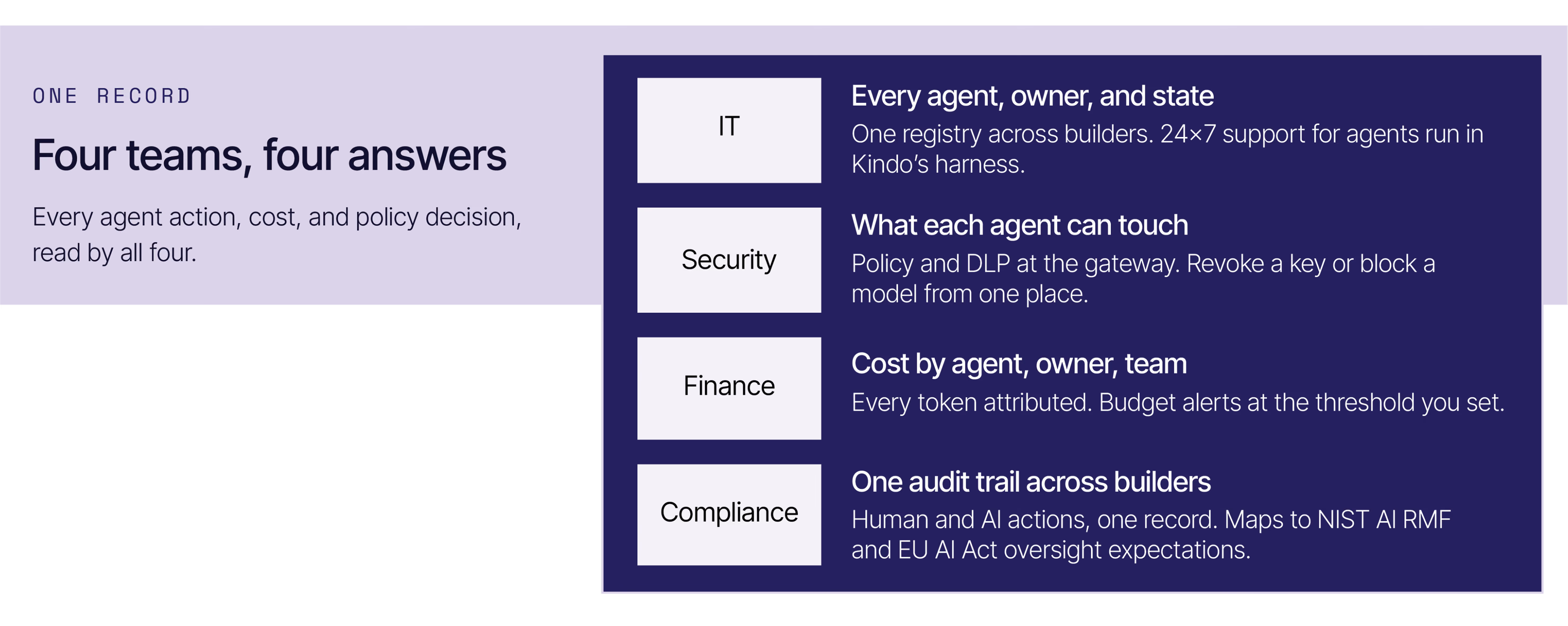
Four teams, four answers
Every agent action, cost, and policy decision, read by all four.
IT
Every agent, owner, and state
One registry across builders. 24x7 support for agents run in Kindo's harness.
Security
What each agent can touch
Policy and DLP at the gateway. Revoke a key or block a model from one place.
Finance
Cost by agent, owner, team
Every token attributed. Budget alerts at the threshold you set.
Compliance
One audit trail across builders
Human and AI actions, one record. Maps to NIST AI RMF and EU AI Act oversight expectations.
Who is AI agent sprawl control for?
The leaders who said yes to agents and need to keep saying it: the CIO and CTO, the CISO, and the central AI platform leader consolidating builders.
CIO and CTO
Say yes without losing the plot
One view across builders. No lock-in to one lab or builder.
CISO
Answer "what can this thing touch"
Inherited permissions. Policy and DLP at the gateway. Every call on record.
AI platform leader
Consolidate without rip and replace
Keep your gateway or model hub. Kindo fronts it and issues the keys harnesses use.
Agents on more than one platform (a suite copilot, a developer harness, an internal builder is the common case)
Agents that read company data or take actions, not only answer questions
Leadership asking what exists, who owns it, what it costs
Why choose Kindo for AI agent sprawl?
Kindo manages agents from anywhere rather than building them in one place, with the three capabilities control needs together: AI Data Gateway, AI Model Gateway, and Role Based Access Control, deployable on premises. Two differences, one objection, and where Gartner stands.
Difference 1
Manage agents from anywhere, not build them in one place
By category. Your gateway and builders keep their jobs.
Approach
Agents governed
Owner per agent
Runtime enforcement
Cost attribution
Record
Runs
Agent development platform
Its own
Its own only
Its own only
Its own usage
Its own log
Vendor cloud
AI gateway
Traffic through it
No; keys, not owners
Model calls only
By key
Call log
Varies
AI governance platform
Declared agents
As declared
Catalog, little runtime
Rarely
Attestations
Vendor cloud
Kindo
Built anywhere, via the gateways
Yes, from your identity provider
Data and model calls; policy, DLP, budget alerts
Every token: agent, owner, team
One Audit Trail across builders
Kindo cloud, yours, on premises, air-gapped
Difference 2
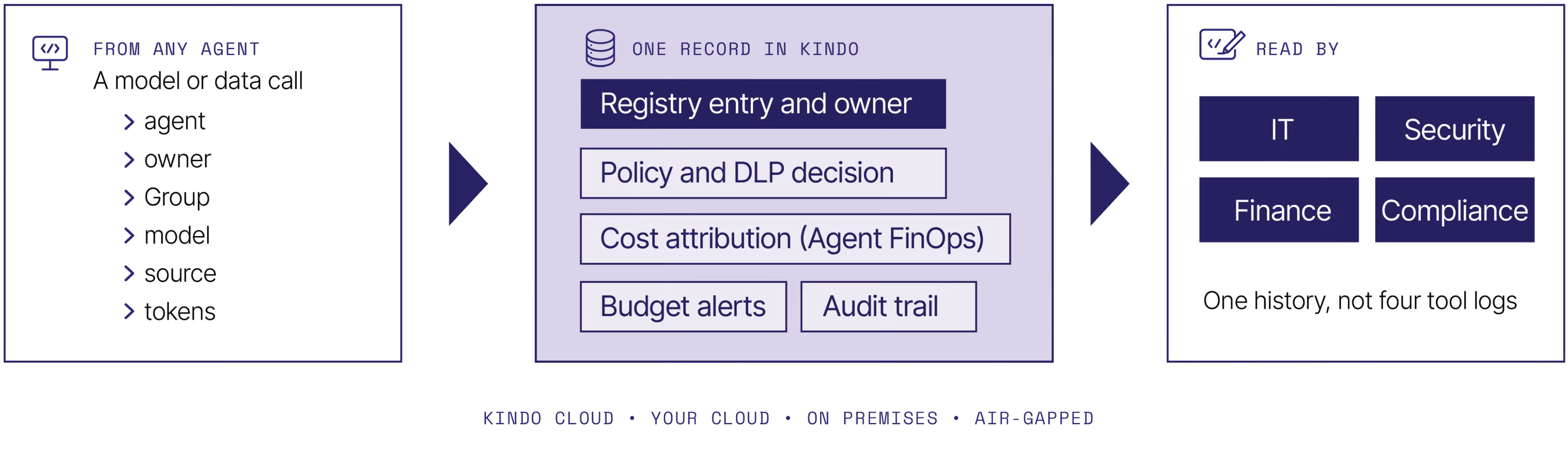
Every agent's activity lands in one record, read by four teams
Not four tool logs.
The objection
"We already have an AI gateway"
Keep it. Row by row, what Kindo adds in front.
A gateway alone
What Kindo adds in front
Sees only traffic routed through it. Agents elsewhere: invisible.
The Unified AI Registry spans agents not routed yet, and names them.
Knows keys, not people. No owner, Group, or inherited permissions.
RBAC ties every agent to an owner and a Group from your identity provider.
Model calls only. Data reads and writes go around it.
The AI Data Gateway puts policy and DLP on every data read and write.
Rarely on premises with identity and data control together.
Keep it as a provider inside Kindo. DLP, policy, cost, audit in front. Any deployment.
How do you get started?
Start with the free assessment: Kindo's pre-built discovery agents build the registry everything else depends on, from sources you already have. Then a demo of how Kindo maps to your agent estate.