Transcript
The Evolution of AI Interfaces
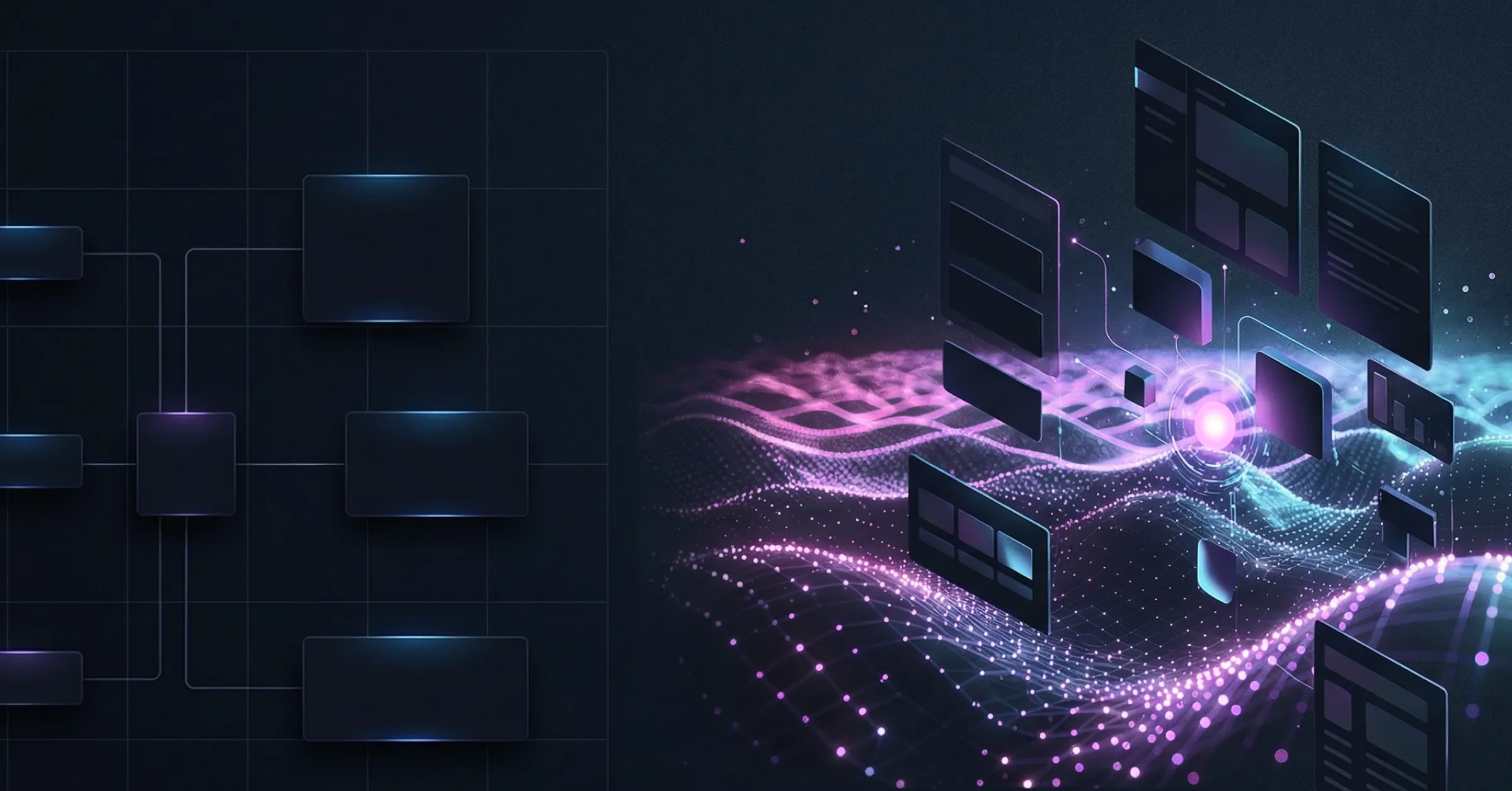
Why Enterprise Interaction Is Moving Beyond Dashboards
For as long as anyone in enterprise software can remember, interaction has looked a certain way. You log into an application. You see a homepage or a dashboard. You click through menus, drill into lists, change views, and switch between tabs until you find the information or action you need.
That model has defined enterprise work for decades. It reflects how systems were built: each application owns its own data, logic, and user interface. If your task spans multiple systems, you navigate between them and carry context in your head.
But the way people actually work has never strictly followed those boundaries.
Most work starts with a goal.
You don’t wake up trying to “use the SIEM.” You wake up trying to determine whether an alert indicates a breach.
You don’t start by opening a finance tool. You start by trying to close a quarter or prepare a forecast.
AI is now exposing the mismatch between how systems are structured and how work actually happens. When an interface can begin with an objective instead of a product, it opens a new possibility: interaction that is shaped by outcomes, not by static screens.
This isn’t about adding another copilot inside an app. It’s about rethinking where the interface lives.
Why the Old Model Starts to Break
Static dashboards and navigation trees work well when a user’s task stays within a single domain. Most meaningful work, however, spans multiple systems. A security investigation, customer onboarding, or a compliance review all require context, data, and action across tools.
In those situations, the interface isn’t the problem. The assumption behind it is.
Traditional interfaces assume you already know:
- which tool you need,
- which view inside that tool,
- how to get the data you need,
- and when to switch to another system.
That puts the cognitive burden entirely on the person. It means mastery of menus and workflows instead of mastery of the work itself.
AI gives us a chance to rethink that assumption.
What It Looks Like When Intent Comes First
Imagine a scenario where a user doesn’t start with a tool at all.
Instead of opening an application and navigating to the right page, they start with a statement of intent:
“I need to investigate this alert and determine whether it’s a real threat.”
That one statement becomes the seed of the interaction.
The system interprets the objective and assembles the relevant pieces of context from across systems. It surfaces identity logs, endpoint activity, related policies, and recent changes in a single view. It doesn’t replace each tool’s interface, but it stitches their capabilities together at the point of need.
The interface becomes less about navigation and more about coordination.
Instead of clicking through ten screens to gather data and then another ten to execute actions, the user sees what matters in the context of the work they are trying to do.
That’s not a dashboard remake. It’s a different way of thinking about UI.
Interfaces That Assemble Around Context
This shift means interfaces may become:
- composed rather than designed linearly
- focused on relevance rather than completeness
- assembled around tasks instead of modules
- short-lived and scoped rather than persistent and monolithic
In an enterprise world shaped by intent, the screen a person sees will look more like a workspace created for that objective than a static app view.
That doesn’t mean clicking disappears. It means the system pre-surfaces the relevant context so clicking happens in the right place with the right constraints.
Supervision, Not Navigation
A key nuance here is that increasing AI involvement doesn’t eliminate the human role. It changes it.
In this model, experts don’t navigate systems. They supervise execution.
They review what the system proposes. They confirm or adjust actions. They bring judgement where rules, context, and ambiguity intersect.
The interface still matters. It just becomes a vehicle for visibility and control rather than menu traversal.
This is especially important in enterprise settings where safety, permissions, and accountability can’t be implicit.
What This Requires Behind the Scenes
To support this new class of interaction, systems need to be:
- Composable — APIs that expose capability across domains
- Governable — policies and permissions that are machine-readable
- Observable — execution trails that are traceable and reviewable
- Coherent — identity and context unified across systems
Without these pieces, you can’t reliably assemble interfaces around intent. You end up with fractured views and unpredictable behavior, which defeats the purpose of moving beyond static dashboards.
That’s why this shift is less about AI in the UI and more about how the stack meets AI at scale.
What This Means for the Future
This is not a claim that menus will disappear tomorrow. It is not a promise of a single interface that works everywhere.
It is an acknowledgment that the old model, static screens bound to siloed systems, does not fit the way work is actually done.
When interaction begins with what you are trying to accomplish, the interface becomes a reflection of context, not an obstacle to it.
Design in this world becomes about supervision, explanation, and constraint, not about navigation or site maps.
The future of enterprise interfaces is not about having more dashboards. It’s about coordinating across systems so work flows naturally from intention to execution and with clarity, control, and accountability.